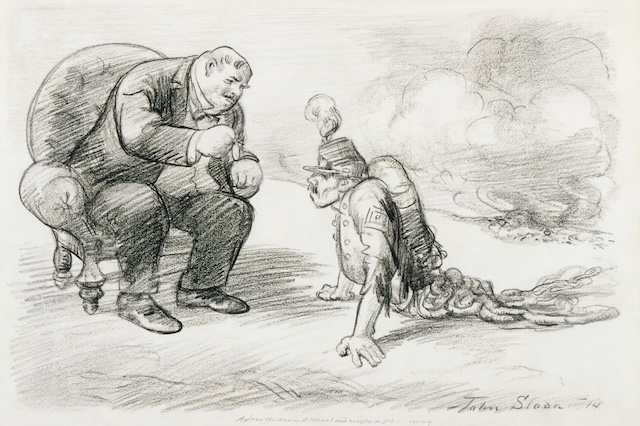
This cartoon was published in 1914, before America entered the First World War. Before Normandy, Vietnam, Fallujah, and Helmand. Before more than a century of speeches promising that this war would be necessary, this one would be different, and couldn't be avoided. The drawing is brutal because it doesn't waste time pretending. A soldier, blown apart and dragging himself forward with his hands, leaves his intestines behind him as he crawls toward a comfortable businessman seated in an oversized chair. The businessman leans forward with a medal in one hand and the possibility of a job in the other. "After the War... A Medal and Maybe a Job." John Sloan wasn't mocking the soldier. He was asking a question that has survived every war in history. Who benefits when nations go to war, and who gets left with the bill? For all the progress we've made over the last hundred years, that question still seems to make people uncomfortable. We've revolutionized the machinery of war. We can watch a battlefield from space, strike a target from another continent, and deliver enough firepower to erase a city before breakfast. Yet somehow the burden of proof for going to war still feels lighter than the burden carried by the people expected to fight it. The men who go are almost always told they are defending freedom, protecting democracy, stopping the next threat before it reaches home. Maybe those claims are true. Maybe they aren't. But if history has taught us anything, it should be that those explanations deserve relentless scrutiny before the first convoy rolls out. Not decades later when the archives finally open and everyone admits the story was all bullshit to justify a far more nefarious plot. The remarkable thing isn't that this cartoon existed in 1914. It's that after more than a century of war, technological progress, and promises that we've learned our lesson, the question it asks is still unanswered. If there is one lesson worth carrying forward, it isn't that every soldier deserves another ribbon. It's that every government should face impossible questions before asking another generation to come home wearing one.
Channel/Medium:
Instagram
onJul 16, 2026Zero Foxtrot
zerofoxtrot.com
Details
This cartoon was published in 1914, before America entered the First World War. Before Normandy, ...
Jul 16, 2026, 1:01 PM
Search thousands of other brands for emails, ads, social media posts, and more.
The Particl web app allows you to see how an email or ad campaign affected sales over time.
Explore emails, ads, and more
Agencies and marketers can cut through the noise and find the best ads, campaigns, and social media content about Zero Foxtrot all in one place. Take it a step further in the Particl app to see how those campaigns are performing.